Ambulance ITH Keyfob: A Designer’s Business Review
As an embroidery designer who frequently consults with small businesses on merchandise development, I approach every machine embroidery design with a critical eye toward commercial viability. When reviewing the Ambulance ITH Keyfob, my primary focus is not just on the aesthetic appeal of the transportation theme, but on how this digital asset performs in a production environment. For shop owners, Etsy sellers, and uniform decorators, an In-The-Hoop (ITH) project must be more than cute; it must be efficient, consistent, and profitable. This review evaluates the Ambulance ITH Keyfob specifically for branded merchandise, staff incentives, and niche market products.
First Impressions: Professional Utility Meets Niche Appeal
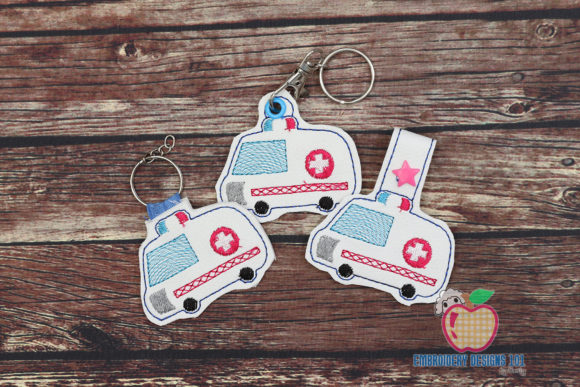
The Ambulance ITH Keyfob immediately strikes a balance between professional utility and recognizable iconography. In the transportation category, ambulance designs can sometimes lean too cartoonish or overly clinical. However, this design feels appropriately bold and respectful, making it suitable for both emergency service personnel and medical transport businesses. The inclusion of three distinct finishing versions—Snap Tab, Eyelet, and Ribbon—is a significant advantage for commercial embroiderers. This versatility allows a single embroidery file to serve multiple product lines without requiring additional digitizing work.
From a business perspective, the 4x4 hoop compatibility is the standout feature. For high-volume production, maximizing output per hour is essential. Being able to run these keyfobs in a standard 4x4 hoop means you do not need to switch to larger hoops or machines, streamlining the workflow for small business merch production. If you have a 5x7 hoop available, you can likely gang multiple units simultaneously, further increasing efficiency during large batch runs for events or staff gifts.
Real-World Applications for Medical and Transport Brands
While primarily a keyfob, the Ambulance ITH Keyfob serves as a foundational asset for broader brand identity within the medical transport sector. I have seen similar ITH designs successfully adapted for various business applications beyond simple keychains.
- Staff Uniform Accents: Use the Snap Tab version as a zipper pull for paramedic jackets or fleece vests. It adds a customized touch to standard issue gear without violating uniform codes.
- Patient and Family Gifts: Pediatric transport services often use the Ribbon version as a comfort item or thank-you gift. The soft construction of an ITH keyfob makes it safe and friendly compared to metal hardware.
- Event Merchandise: For EMS conferences or community safety fairs, these keyfobs are high-perceived-value items with low material costs. They function as memorable takeaways that reinforce organizational recognition.
- Boutique Medical Apparel: Sellers specializing in nurse or EMT accessories can use the Eyelet version to create bag charms for tote bags or backpacks, expanding their product catalog with minimal overhead.
For creative studios or handmade brands focusing on first responder themes, this design acts as a reliable base for custom apparel add-ons. It bridges the gap between functional gear and personalized expression, which is crucial for buyer engagement in niche markets.
Technical Considerations for Commercial Production
Despite its versatility, there are specific technical constraints to consider before adding the Ambulance ITH Keyfob to your permanent lineup. As with any commercial embroidery project, understanding the limitations prevents costly rework and customer dissatisfaction.
Fabric Texture and Stabilizer Choices
ITH projects rely heavily on the stability of the sandwich layers. Because this design includes hardware integration points (snap tabs and eyelets), you must ensure your stabilizer choice supports the stress of daily use. For medical transport merchandise that may face frequent cleaning or rough handling, avoid lightweight tear-away stabilizers. Instead, opt for a medium-weight cut-away or a specialized ITH fusible stabilizer to prevent puckering around the attachment points. Always test on the actual fabric texture you intend to use; vinyl and faux leather behave differently than cotton twill, affecting tension and registration.
Hoop Size and Registration Accuracy
Although the design is 4x4 friendly, precision is paramount. Small alignment errors in ITH projects can result in exposed raw edges or misaligned snap placements. Before running a full production batch, verify that your machine’s hoop tension is correct. If you are scaling up to a 5x7 hoop to stitch multiple units, ensure your machine maintains consistent tension across the entire field. Uneven tension in multi-position hooping can lead to inconsistent sizing, which looks unprofessional in retail settings.
Thread Colors and Contrast
Ambulance designs typically utilize high-contrast colors like white, red, and reflective silver. When selecting thread colors, prioritize colorfastness and UV resistance if the keyfobs will be attached to outdoor gear or vehicle keys. High stitch density areas, common in emblem-style transportation designs, can cause thread breaks if the tension is too tight. Review the design’s density map; if it feels excessively stiff after a test run, consider using a lighter weight bobbin thread to reduce bulk while maintaining top-side coverage.
Strengthening Brand Value Through Quality Control
The quality of your finished product directly impacts customer trust and perceived value. A frayed edge or a crooked snap tab on an Ambulance ITH Keyfob reflects poorly on the professionalism of the medical or transport brand it represents. To maintain high standards, implement a rigorous testing protocol.
- Create a Printable Mockup: Before stitching, visualize the placement of text and icons. Ensure the design aligns with other design assets in your brand kit. Consistency across patches, caps, and keyfobs builds a cohesive visual identity.
- Test in Black and White: Run a grayscale test stitch-out to evaluate contrast and detail definition without the distraction of color. This reveals if fine lines in the ambulance detailing are legible at the finished size.
- Verify Hardware Compatibility: Not all snaps and eyelets are identical. Confirm that the design’s placement stitches match the exact dimensions of your hardware supplier’s components. A mismatch here renders the ITH file unusable.
- Wash and Wear Testing: If marketing these for apron embroidery or uniform attachments, subject the sample to repeated washing cycles. Check for shrinkage, color bleeding, and hardware integrity.
Licensing and Business Compliance
Before selling any item featuring the Ambulance ITH Keyfob, thoroughly review the licensing terms associated with the digital embroidery file. Commercial use rights vary significantly between designers. Some licenses permit unlimited sales of physical items but prohibit mass production or outsourcing. Others may restrict the use of trademarked medical symbols or specific ambulance markings. Ensuring compliance protects your business from legal issues and respects the intellectual property of the digitizer. Additionally, always credit the designer where appropriate in your listings; this transparency builds trust with customers who value ethical sourcing in the handmade product community.
Final Verdict for Embroidery Businesses
The Ambulance ITH Keyfob is a robust, commercially viable asset for businesses serving the transportation and medical sectors. Its 4x4 compatibility and three-in-one finishing options offer excellent ROI for shops looking to expand their tote bag design accessories or uniform accents. By adhering to proper stabilizer protocols, testing hardware compatibility, and respecting licensing terms, this design can become a staple in your commercial embroidery catalog. Remember, in the world of branded merchandise, consistency and durability are just as important as the design itself. Treat this file as a professional tool, and it will deliver professional results for your clients and customers.